
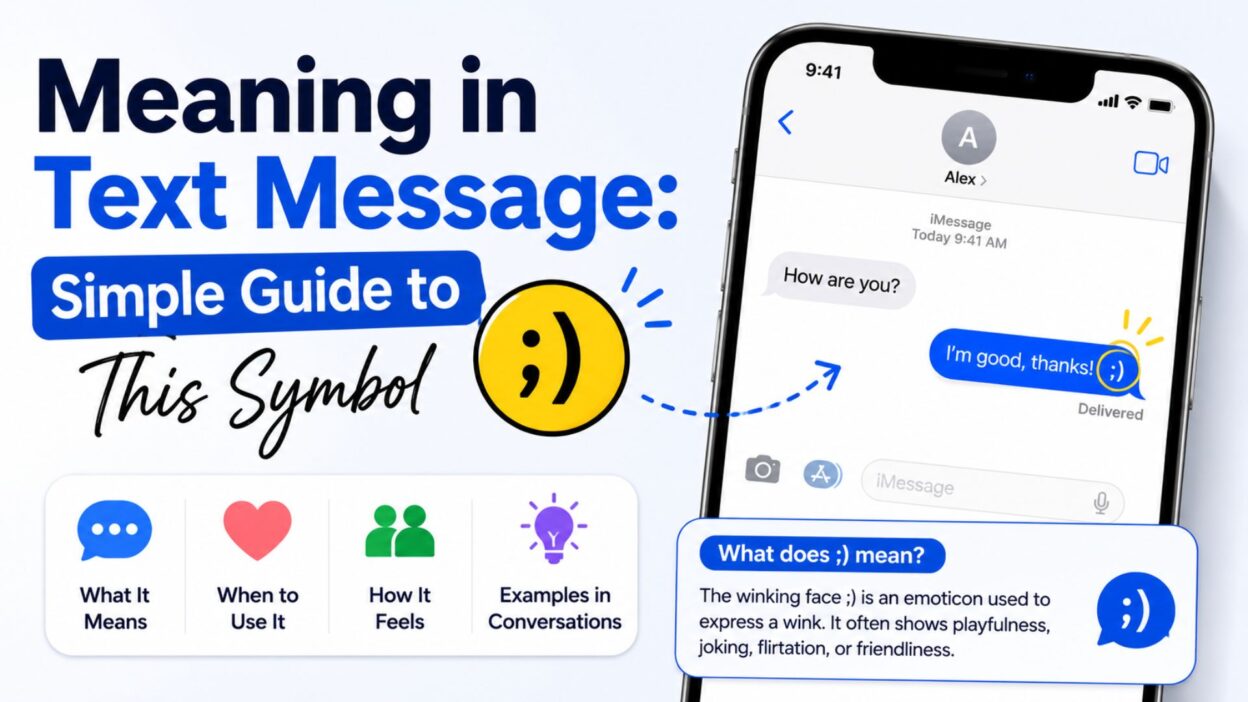
Have you ever received a message that ends with just a “)” and wondered what it means? At first glance, it may seem like a random punctuation mark. However, in texting, even a single symbol can carry emotion, personality, or hidden meaning. That’s why many people search for “) meaning in text message” after seeing it in a conversation.
The good news is that the meaning is usually simple. In most cases, a single closing parenthesis represents a smile or a friendly tone. It’s a shortcut people use instead of typing a full emoji like 😊 or 🙂. Depending on the conversation, though, the symbol can also suggest playfulness, light sarcasm, or a subtle sign of warmth.
In this guide, you’ll learn exactly what “)” means in text messages, why people use it, how its meaning changes in different situations, and when you should or shouldn’t use it. By the end, you’ll understand this small symbol with confidence.
What Does “)” Mean in a Text Message?
In texting, a single “)” usually represents a smile. Although it looks simple, it helps make a message sound warmer, friendlier, or more relaxed.
Here are the most common meanings:
- 😊 It often means I’m smiling.
- 🙂 It adds a friendly tone to a message.
- 💬 It softens words that might sound too serious.
- 😄 It shows happiness or satisfaction.
- 👍 It makes a reply feel more welcoming.
- 💕 Sometimes it expresses affection.
- 😉 It can suggest light playfulness.
- 😌 It helps conversations feel more natural.
- 📱 Many people use it instead of an emoji.
- ✅ In most cases, it has a positive meaning.
Why Do People Use “)” Instead of Emojis?
Some people prefer typing symbols instead of tapping emojis. As a result, the closing parenthesis remains popular in many conversations.
Common reasons include:
- 📱 It’s faster to type.
- ⌨️ It works on every keyboard.
- 😊 It creates a simple smile.
- 💬 It keeps messages short.
- 🎯 It looks less formal than punctuation alone.
- 🌍 It’s common in many online communities.
- 😄 Some people simply prefer classic text symbols.
- ⚡ It saves time during quick chats.
- 🤝 It adds warmth without using colorful emojis.
- ✔️ Many long-time texters still use it every day.
Common Meanings of “)” in Different Conversations
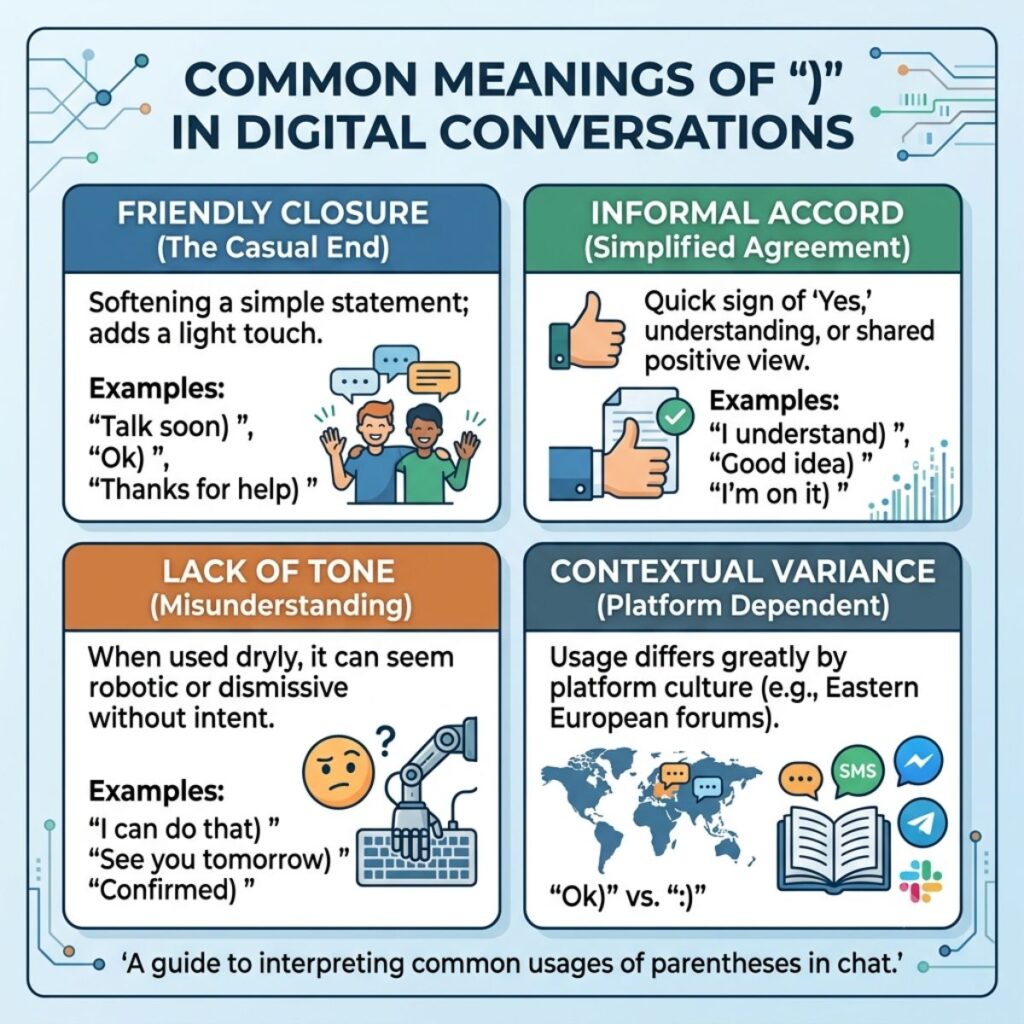
The meaning of “)” depends on the conversation. Even so, it almost always carries a positive or friendly tone.
Here are several possible meanings:
- 😊 A friendly smile.
- 😄 Happiness.
- 😉 Gentle teasing.
- 💕 A caring response.
- 😌 Feeling relaxed.
- 🤗 Warmth.
- 👍 Agreement.
- 🎉 Excitement.
- 😅 A lighthearted reply.
- 💬 A casual ending to a conversation.
Does “)” Mean Someone Is Flirting?
Sometimes people wonder whether this symbol signals romantic interest.
The answer depends on the conversation.
- 💕 It can sound slightly flirty.
- 😊 Most of the time, it’s simply friendly.
- 😉 Context matters more than the symbol itself.
- 💬 One parenthesis alone doesn’t confirm flirting.
- ❤️ Repeated use with compliments may feel more personal.
- 📱 Friends also use it regularly.
- 😄 Many people type it out of habit.
- 🤝 It usually creates a warm tone.
- 💡 Look at the entire conversation before assuming anything.
- ✅ In most chats, it simply represents a smile.
Examples of “)” in Text Messages
Seeing real examples makes the meaning easier to understand.
- 💬 “Thanks for helping me today )”
- 💬 “I’m glad everything worked out )”
- 💬 “Talk to you later )”
- 💬 “That was really funny )”
- 💬 “Hope you have a great day )”
- 💬 “Good luck with your interview )”
- 💬 “I finally finished the project )”
- 💬 “Don’t worry, everything will be okay )”
- 💬 “See you tomorrow )”
- 💬 “You made me laugh )”
Each example sounds a little friendlier because of the closing parenthesis.
Does “)” Have Different Meanings on Different Platforms?
Although the symbol looks the same everywhere, its meaning can change slightly depending on where you see it. Even so, it almost always conveys a friendly or positive emotion.
Here are some common examples:
- 📱 Text Messages: Usually means a simple smile.
- 💬 WhatsApp: Adds warmth to a conversation.
- 📘 Facebook Messenger: Makes replies feel more casual.
- 📸 Instagram DMs: Often expresses happiness or friendliness.
- 🐦 X (Twitter): Can soften a comment or joke.
- 💼 Work Chats: Used less often but may make messages sound more approachable.
- 🎮 Gaming Chats: Shows a relaxed or playful mood.
- 💻 Online Forums: Frequently replaces a smiling emoji.
- 🌍 International Chats: Common in countries where text emoticons remain popular.
- ✅ Overall, the meaning stays positive across most platforms.
What Does “))” or “)))” Mean?
Sometimes you’ll see two or three closing parentheses instead of just one. In many online communities, adding more parentheses increases the level of friendliness or happiness.
Here are the most common meanings:
- 😊 “)” = Small smile.
- 😄 “))” = Bigger smile.
- 😂 “)))” = Very happy or laughing.
- 🤗 Several parentheses often show extra warmth.
- 💬 Some people use them out of habit.
- 🌍 This style is especially common in parts of Eastern Europe and Russia.
- 🎉 Multiple parentheses can make a message feel more cheerful.
- ❤️ Friends often use them in casual conversations.
- 😆 They can replace laughing emojis.
- ✔️ More parentheses usually mean stronger positive emotion.
When Should You Use “)”?
Using this symbol can make your messages feel more natural. However, it’s best to use it in casual conversations instead of formal communication.
Good situations include:
- 😊 Chatting with friends.
- 💕 Texting family members.
- 💬 Casual conversations.
- 🎉 Celebrating good news.
- 🤝 Thanking someone.
- 😄 Replying to jokes.
- 📱 Ending a friendly message.
- 🌞 Wishing someone a good day.
- ❤️ Showing appreciation.
- 👍 Making your tone sound warmer.
When Should You Avoid Using “)”?
Although it’s friendly, the symbol doesn’t fit every situation.
Consider avoiding it in these cases:
- 💼 Formal business emails.
- 📄 Professional reports.
- ⚖️ Legal documents.
- 🏢 Official workplace announcements.
- 📚 Academic assignments.
- 📧 Job applications.
- 📝 Professional customer support replies.
- 🚨 Serious emergency messages.
- 💔 Messages about sensitive topics.
- ✔️ Any situation that requires a formal tone.
Common Misunderstandings About “)”
Many people overthink this tiny symbol. Fortunately, most of the common assumptions are incorrect.
Myth: It Always Means Flirting
Many users assume someone is flirting whenever they use “)”.
- ✅ Fact: Most people simply use it as a smile.
Myth: Only Young People Use It
Some believe only teenagers type closing parentheses.
- ✅ Fact: People of all ages use text emoticons.
Myth: It’s the Same as Every Emoji
Many users think “)” carries the exact meaning as 😊.
- ✅ Fact: It usually represents a smile, but it often feels simpler and more subtle.
Myth: One Parenthesis Is a Typing Mistake
Some people think the sender forgot to type the opening parenthesis.
- ✅ Fact: In texting culture, a single closing parenthesis intentionally represents a smile.
Myth: More Parentheses Change the Meaning Completely
People sometimes think “)))))” has a hidden meaning.
- ✅ Fact: It usually just expresses a bigger smile or stronger positive emotion.
Quick Tips for Understanding “)” in Text Messages
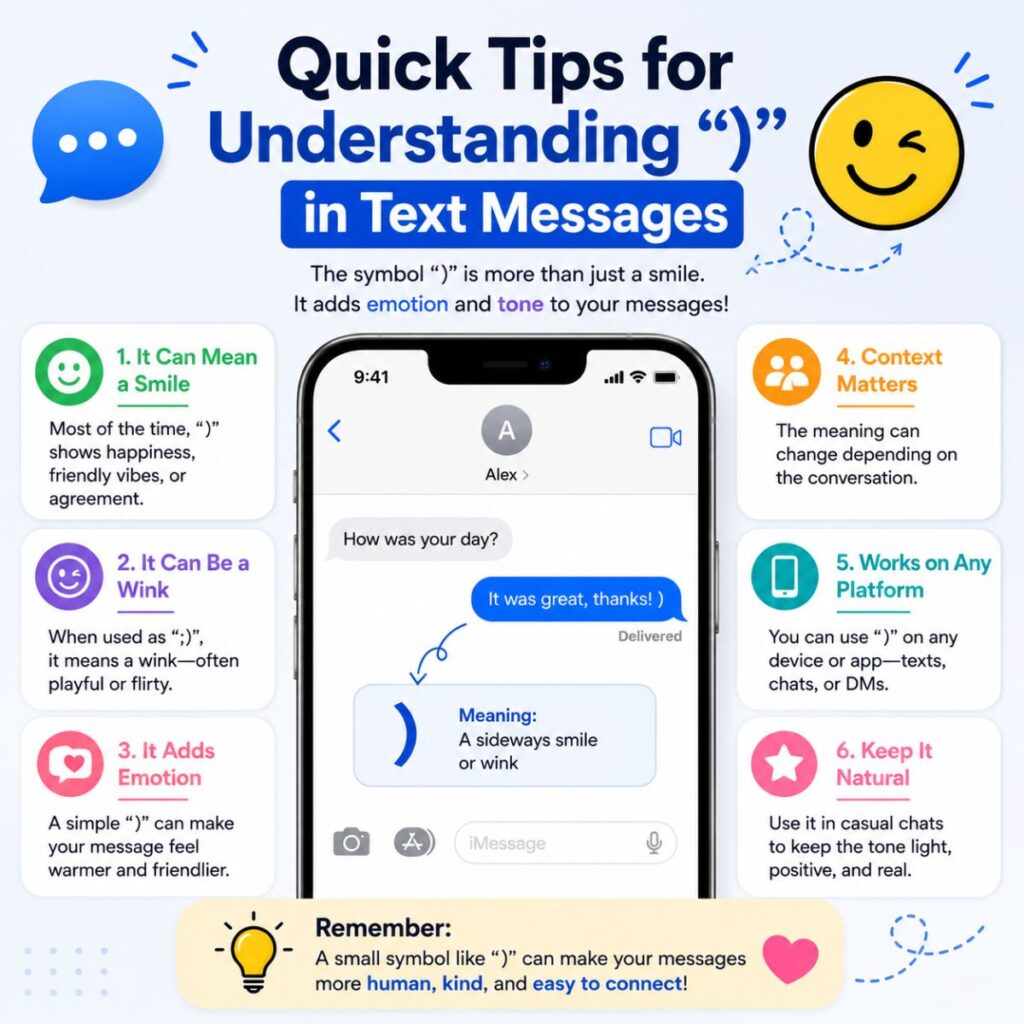
Keep these simple tips in mind whenever you see this symbol.
- ✔️ Read the entire conversation.
- ✔️ Look at the sender’s usual texting style.
- ✔️ Remember that context matters.
- ✔️ Don’t assume romantic interest immediately.
- ✔️ Notice whether other emojis appear nearby.
- ✔️ Multiple parentheses usually mean a bigger smile.
- ✔️ In most cases, the tone is friendly.
- ✔️ Don’t overanalyze a single symbol.
- ✔️ Ask politely if you’re unsure.
- ✔️ Enjoy the conversation instead of focusing on one character.
Frequently Asked Questions
What does “)” mean in a text message?
In most text messages, “)” means a simple smile. People use it to make their messages sound friendlier, warmer, or more positive without using an emoji.
Is “)” the same as a smiley face?
Yes, in many conversations it works like a simple smiley. Instead of typing 🙂 or 😊, some people prefer using a single closing parenthesis because it’s quicker and gives the message a relaxed tone.
Does “)” mean someone likes me?
Not necessarily. Although it can sound warm or slightly playful, “)” usually doesn’t indicate romantic interest by itself. The overall conversation and the sender’s behavior provide much better clues.
What does “))” or “)))” mean in texting?
Two or more closing parentheses usually represent a bigger smile or stronger positive emotion. Many people use “))” or “)))” to show extra happiness, excitement, or friendliness.
Should I use “)” in professional messages?
It’s better to avoid using “)” in formal emails, business communication, or official documents. Instead, save it for casual chats with friends, family, or people you know well.
Final Thoughts
If you’ve ever searched for “) meaning in text message”, the good news is that the symbol is usually easy to understand. In most conversations, a single closing parenthesis simply represents a smile and adds a friendly, relaxed tone to the message. Rather than sounding cold or overly formal, it helps make conversations feel more natural and approachable.
Although “)” can occasionally seem playful or even slightly flirty, the meaning almost always depends on the context. Looking at the entire conversation is much more helpful than focusing on one character alone. A simple symbol rarely tells the whole story.
We hope this guide has answered your questions and made texting symbols easier to understand. Save this article for future reference, and share it with friends or family who have wondered about “) meaning in text message. Sometimes, even the smallest character can say more than you expect.

Awais Bilal is the author of Messagesfy, sharing simple and meaningful messages, quotes, and wishes to help people express their feelings easily.