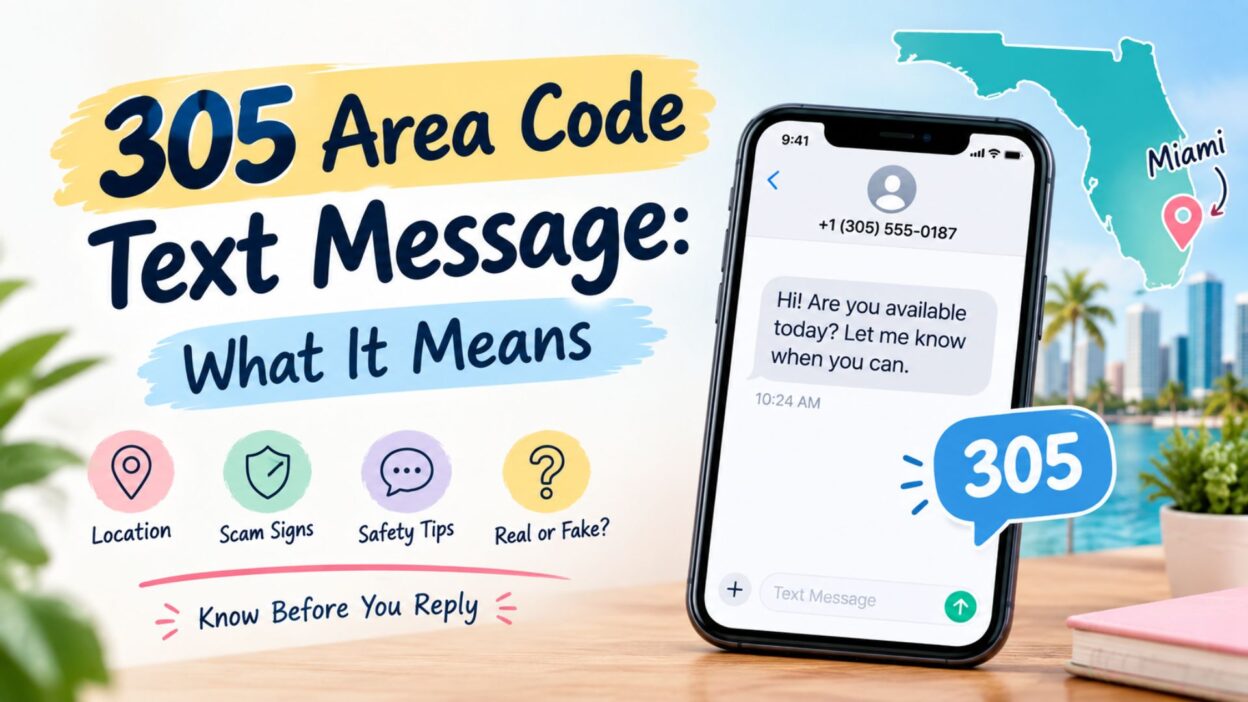
Getting an unexpected text from a number starting with 305 can leave you wondering who sent it and why. If you searched for 305 area code text message, you probably want to know where the number comes from and whether you should trust the message.
The 305 area code belongs to Florida, particularly the Miami-Dade County area and the Florida Keys. However, an area code alone cannot tell you who actually sent a message. Caller ID and phone numbers can also be spoofed, so an unfamiliar 305 number deserves a little caution.
This guide explains what a 305 text message can mean, why you might receive one, and which signs deserve attention. Most importantly, you will learn how to check an unexpected message without rushing into a reply or clicking a suspicious link.
What Does a 305 Area Code Text Message Mean?
A 305 area code text message simply means the sender’s phone number uses the 305 area code. It does not automatically mean the message comes from a scammer, nor does it guarantee that the sender currently lives in Miami.
The 305 code serves Miami-Dade County and the Florida Keys. The region also uses other area codes, including 786 and 645, because additional numbering capacity became necessary as demand for phone numbers grew.
Therefore, the area code gives you a geographic clue, not a complete identity. A person may keep a 305 number after moving somewhere else, while a business may use a local number to serve customers in the Miami area.
Where Is Area Code 305 Located?
Area code 305 is associated with southeastern Florida. Its main service area includes Miami-Dade County and the Florida Keys.
Cities and Areas Associated With 305
The 305 region includes well-known places such as:
- Miami
- Miami Beach
- Hialeah
- Coral Gables
- Homestead
- Parts of the Florida Keys
Because 305 has a long history in South Florida, many residents, businesses, and organizations use numbers with this code. As a result, receiving a legitimate text from a 305 number is completely possible.
At the same time, the location shown by a phone number does not prove where the sender is physically located. People can move without changing their phone numbers, and scammers can manipulate caller ID information.
Why Did I Get a Text From a 305 Number?
There are several ordinary reasons you might receive a message from a 305 number. For example, someone you know may have a Florida number, a business may contact you about an appointment, or you may have previously interacted with an organization that uses a 305 number.
Sometimes, however, the sender simply has the wrong number. A stranger might send a casual message because they accidentally entered one digit incorrectly.
Common Legitimate Reasons
A 305 text could come from:
- A friend, relative, or acquaintance with a 305 number
- A local business or service provider
- An appointment or reservation reminder
- A delivery or customer-service notification
- Someone who accidentally entered the wrong number
So, seeing 305 on your screen does not tell you whether the message is legitimate. Instead, look at the content and consider whether you were expecting contact.
Can a 305 Text Message Be a Scam?
Yes, a scammer can use a 305 number. However, that does not mean every 305 text is a scam.
The Federal Trade Commission warns that scammers send unexpected texts to encourage people to click links, provide personal information, or respond to fake account and payment alerts. The FTC also explains that scammers can manipulate caller ID information, which means a displayed number does not always reveal the sender’s true location.
Therefore, judge the message itself rather than relying only on the 305 area code.
Warning Signs to Notice
An unexpected text deserves extra caution when it:
- Creates urgency and tells you to act immediately
- Asks for passwords, account details, or financial information
- Includes an unexpected link
- Claims you won a prize or received a reward
- Says your payment or account has a problem
- Pretends to be a delivery company and asks you to update information
- Starts with a vague message such as “Hi, how are you?” from someone you do not know
For instance, the FTC has warned about fake delivery, bank-alert, job, and “wrong number” texts that try to start a conversation or push recipients toward a link.
Should You Reply to an Unknown 305 Text?
If you do not recognize the sender and you were not expecting the message, it is safer not to reply immediately.
A simple response such as “Who is this?” may seem harmless. However, the FTC warns that replying to some unexpected texts can confirm that your number is active and may encourage additional unwanted messages.
Instead, pause and examine the message first. If it claims to come from a company you actually use, verify the information through the company’s official website or app rather than using a link or phone number included in the text.
What Should You Check First?
Before responding to a 305 text, consider the context. Did you recently order something, schedule an appointment, contact a business, or give someone your number?
Also, read the wording carefully. A legitimate message may provide useful context, while a suspicious message often pushes you toward an immediate action.
Most importantly, never let the area code alone make the decision for you. A 305 number can belong to a real person or organization, while a scammer can also make a number appear local.
The next step is to look more closely at the message itself and understand the common types of texts people receive from unfamiliar numbers.
Common Types of 305 Area Code Text Messages
Not every unexpected text follows the same pattern. Some messages come from real people or businesses, while others try to start a conversation before making a request.
Therefore, the wording and context matter more than the area code itself. Here are some common types of messages you may encounter.
Wrong-Number Texts
A wrong-number message often begins with something simple, such as “Hi” or “Are you available?” The sender may then claim they contacted the wrong person.
Sometimes, a genuine person really has entered the wrong number. However, the Federal Trade Commission has also warned about scams that begin with unexpected “wrong number” conversations and gradually try to build trust or move the recipient toward another interaction. (consumer.ftc.gov)
For that reason, avoid sharing personal details simply because the sender sounds friendly.
Business or Appointment Messages
A 305 number may also belong to a legitimate business. You might receive a reminder about an appointment, delivery, reservation, or customer-service request.
If the message matches something you recently arranged, check the details carefully. However, do not assume it is genuine simply because it mentions a company you recognize.
Instead, open the company’s official website or app yourself. Then confirm the appointment, order, or account information there.
Delivery or Package Messages
Unexpected package messages often attract attention because they create a sense of urgency. A text may claim that a delivery needs an address update or that a small payment remains due.
The FTC has specifically warned consumers about fake package-delivery messages that use links to obtain personal or financial information. (consumer.ftc.gov)
If you receive such a message, check your order through the retailer or delivery company’s official website rather than following the text’s link.
How to Tell if a 305 Text Looks Suspicious
A single warning sign does not automatically prove that a message is fraudulent. Still, several warning signs together should make you slow down.
Look at the Message’s Purpose
First, ask yourself why the sender contacted you. Does the message relate to something you recently did?
For example, an appointment reminder makes sense if you actually booked an appointment. On the other hand, a message about an account you never opened deserves much more caution.
Check for Urgency
Scammers often try to make recipients act before they have time to think. Words such as “immediately,” “final warning,” or “your account will close today” can create unnecessary pressure.
A legitimate organization may sometimes send urgent notices. Even so, you should verify the claim independently before taking action.
Be Careful With Links
An unexpected link deserves special attention. The FTC recommends avoiding links in unexpected text messages and contacting the relevant company through a website or phone number you already know is genuine. (consumer.ftc.gov)
You do not need to open a link simply to find out where it goes. Instead, verify the information through a trusted source.
What If the Text Asks for Personal Information?
Treat unexpected requests for sensitive information carefully. A message might ask for your password, verification code, bank details, payment information, or other private data.
A genuine organization should not require you to reveal sensitive information simply because an unknown number sent you a text.
Never Share Verification Codes
If an unfamiliar sender asks you to forward a verification code, stop and check the situation first. Verification codes can help protect accounts, so sharing one with another person can create security problems.
Likewise, never send passwords or financial information in response to an unexpected text.
Verify the Sender Independently
Suppose a message claims to come from your bank. Instead of replying to the text, open your bank’s official app or type its known website address yourself.
The same approach works for retailers, delivery companies, schools, and other organizations. Independent verification gives you a safer way to determine whether the message has a real purpose.
What Should You Do With a Suspicious 305 Text?
If the message looks suspicious, you do not need to continue the conversation. In many cases, the simplest response is to avoid replying and avoid clicking anything inside the message.
You can also use your phone’s built-in tools to block the sender or report the message as spam. The exact steps depend on whether you use an iPhone, Android phone, or another messaging service.
If You Already Clicked a Link
Do not panic. Instead, stop interacting with the suspicious page and avoid entering additional information.
If you entered a password, change it through the official service. If you provided financial information, contact the relevant financial institution through its official contact method and explain what happened.
If you only opened a link without entering information, you can still take sensible precautions. Close the page, avoid further interaction, and watch for unusual account activity.
Can You Find Out Who Owns a 305 Number?
The 305 area code can tell you about the number’s numbering region, but it does not provide a reliable identity for the person texting you.
Public phone-number lookup services may provide information about some numbers. However, results can be incomplete, outdated, or inaccurate.
Therefore, do not treat an online lookup result as definite proof of someone’s identity. If a message makes an important claim, verify that claim through an independent and trusted source.
Is Every 305 Text Message Spam?
No. A 305 number can belong to an ordinary person, a legitimate business, or an organization serving South Florida.
At the same time, scammers can use local-looking numbers. The FTC notes that scammers can manipulate caller ID information, so the displayed number does not prove who actually sent the communication. (consumer.ftc.gov)
For this reason, focus on the message’s content, the request it makes, and whether you expected the contact.
How to Handle an Unexpected Text Safely
A simple process can help you avoid unnecessary problems.
- Pause: Do not respond immediately to an unfamiliar message.
- Check the context: Think about whether you expected contact from that person or organization.
- Inspect the request: Be cautious if the message asks for money, personal information, passwords, or codes.
- Avoid unexpected links: Visit the official website or app independently instead.
- Verify important claims: Contact the organization through a trusted channel.
- Block or report suspicious messages: Use your phone’s available spam-reporting features.
These steps do not require you to identify the sender with certainty. Instead, they help you make a safer decision before you interact with an unfamiliar number.
What About Friendly 305 Text Messages?
A friendly message can still come from a genuine person. For example, someone may simply have saved the wrong number or contacted you by mistake.
However, friendliness alone does not prove that the sender has good intentions. If an unknown conversation quickly turns toward investments, payments, account information, gifts, or links, step back and verify the situation.
That small pause can help you avoid turning an ordinary-looking text into a bigger problem.
What to Do After Receiving a 305 Area Code Text Message
Once you understand the message’s context, you can decide how to handle it without rushing. A 305 number does not automatically indicate a problem, so focus on what the sender wants and whether the contact makes sense.
If the message looks legitimate and matches something you recently requested, verify it through a trusted source. On the other hand, if the sender asks for sensitive information, money, or an unexpected login, take a step back before doing anything.
When You Can Ignore the Message
Ignoring an unexpected text often makes sense when you do not recognize the sender and the message provides no useful context.
For example, a simple “Hi” from an unknown number does not require a response. Likewise, a vague offer or unexpected promotion may not deserve your attention.
If the sender continues contacting you, your phone may allow you to block the number or report it as spam.
When You Should Verify the Message
Verification matters when the message claims to involve an account, payment, delivery, appointment, or other important matter.
Instead of using information supplied in the text, contact the organization through an official website, app, or phone number you already trust. That approach helps you separate a genuine notification from an impersonation attempt.
305 Area Code Text Message Safety Tips
A few simple habits can make unfamiliar texts easier to handle. Most importantly, do not let curiosity push you into clicking an unexpected link or sharing private information.
Keep these points in mind:
- Check whether you expected the message.
- Read the entire text before taking action.
- Do not share passwords or verification codes.
- Avoid sending financial information through an unexpected text.
- Treat unfamiliar links with caution.
- Verify business messages through official channels.
- Block numbers that repeatedly send unwanted messages.
- Report suspicious texts through the tools available on your phone or mobile service.
These habits can help whether the message comes from a 305 number or another area code.
What Does the 305 Area Code Tell You?
The 305 area code primarily points to the Miami-Dade County and Florida Keys region of Florida. However, it does not identify a specific person, business, or physical location.
Phone numbers can remain with people after they move. In addition, caller ID information can sometimes be manipulated. Therefore, the area code provides useful geographic context, but you should not use it as proof of identity.
That distinction matters when you receive an unfamiliar text. Instead of asking only, “Where is this number from?” also ask, “Why is this person contacting me, and what do they want me to do?”
Frequently Asked Questions
Is 305 a Florida area code?
Yes. Area code 305 serves Miami-Dade County and the Florida Keys in Florida. The region also uses other area codes because of the area’s demand for telephone numbers.
Is a text from a 305 number automatically a scam?
No. A 305 number may belong to a real person, business, or organization. However, scammers can also use numbers that appear local, so examine the message rather than relying only on its area code.
Should I reply to a random 305 text?
If you do not recognize the sender or were not expecting the message, consider not replying. Instead, check whether the message contains a legitimate reason for contacting you and avoid clicking unexpected links.
Can a 305 number belong to someone outside Florida?
Yes. A person can keep a phone number after moving to another state or region. Also, caller ID information does not always prove the sender’s current location.
What should I do if a 305 text asks for money?
Do not send money immediately. Verify the request independently through the official website, app, or contact information of the claimed organization. If the request seems suspicious, block or report the message.
Final Thoughts on 305 Area Code Text Messages
A 305 area code text message can have many explanations. It may come from a friend, business, service provider, or someone who simply entered the wrong number. Therefore, seeing the 305 area code alone does not tell you whether the message deserves trust.
At the same time, unexpected texts deserve a careful look when they request personal information, money, verification codes, or quick action. Scammers can make messages appear local, so a familiar-looking area code should not remove normal safety checks.
The safest approach is simple: pause, read the message carefully, and verify important claims independently. If something feels unclear, you do not need to respond just because someone contacted you.
Ultimately, the number tells you only part of the story. The message’s context, request, and credibility matter far more than the 305 area code itself.

Awais Bilal is the author of Messagesfy, sharing simple and meaningful messages, quotes, and wishes to help people express their feelings easily.